
Concrete Cleaning, Any Surface
Concrete is porous, which is why it holds every stain it ever meets. Patios, pool surrounds, garage floors, stairs, aggregate — we clean the material properly, whatever shape it takes.
Concrete looks solid and behaves like a sponge. That single fact explains almost everything about why concrete surfaces around a mid-Island home end up looking the way they do.
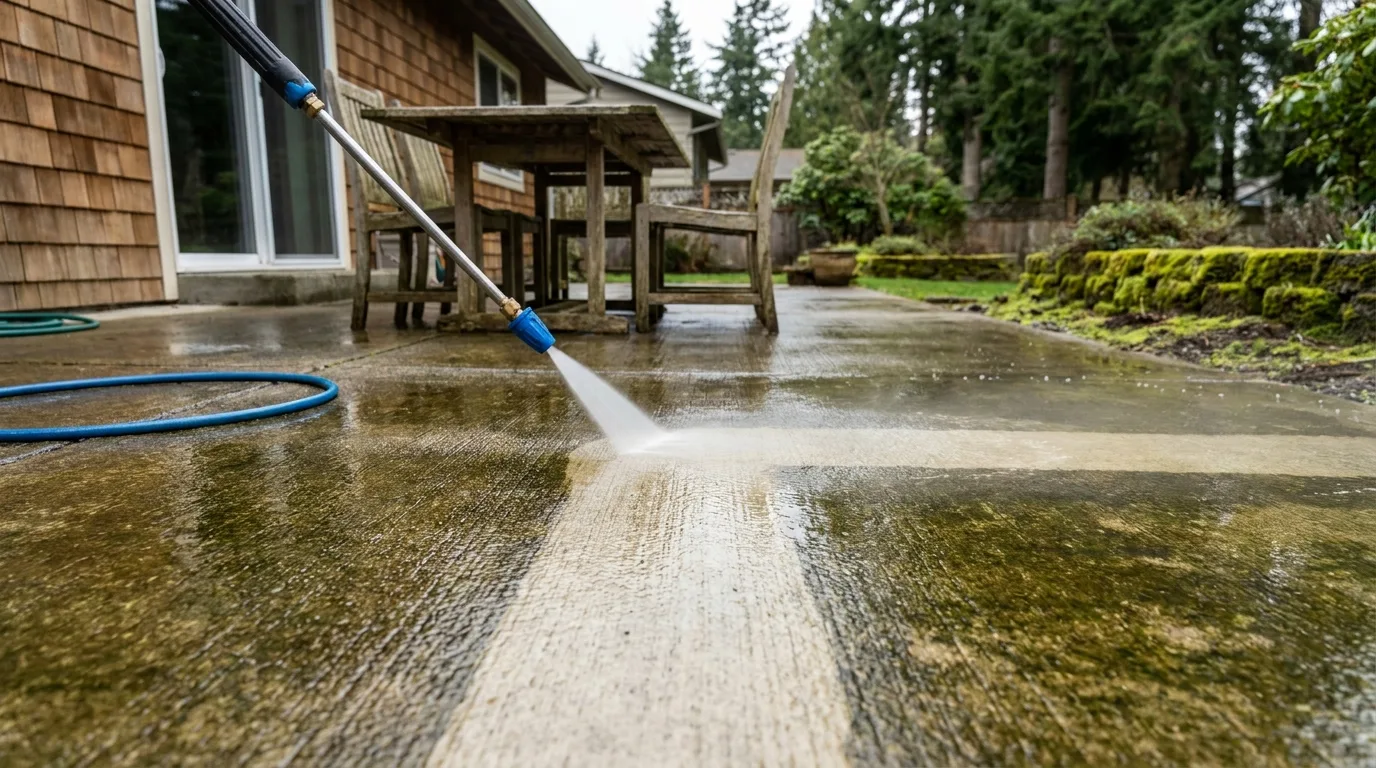
Cured concrete is full of capillaries — microscopic voids left as water leaves the mix. Liquid wicks into them. Airborne spores settle into them. Organic matter breaks down inside them. So a patio does not just get dirty on the surface, it gets dirty *within* the surface, which is why sweeping does nothing and hosing does very little. Cleaning concrete properly means lifting material out of the pores, not wiping the top.
What we clean
Anywhere the material shows up: back patios and entertaining areas, pool and hot tub surrounds, garage and shop floors, concrete stairs and landings, retaining walls, carport and shed slabs, basement and crawlspace entries, exposed aggregate, stamped and coloured concrete, and breeze-block and concrete-block walls.
If it is concrete and it is outdoors, this is the service. Driveways and public-facing walkways have their own pages because they have their own particular problems, but the material knowledge is the same.
The four things staining your concrete
Organic growth. Algae, moss, lichen and mildew, feeding on the organic film that collects in the pores. It is what gives shaded concrete that green-black cast, and it is by far the most common issue on this coast.
Efflorescence. The chalky white bloom that appears on concrete and block walls, especially in the first few years and especially after a wet stretch. It is not dirt and it is not mould. It is salt: moisture moving through the concrete dissolves mineral salts, carries them to the surface, evaporates and leaves them behind as a crust. Brushing spreads it. It needs a specific approach, and if the moisture source behind it never changes, it will come back.
Tannin and leaf staining. Fir needles, cedar shed, maple leaves and bark mulch left sitting on a wet patio all leach tannins into the pores and leave dark blotches that outlast the debris by years.
Rust, mineral and iron staining. Orange marks from irrigation water, planters, metal furniture feet and anything ferrous left standing on the slab.
Each of those wants a different treatment. Throwing pressure at all four is how people end up with a slab that is clean in patches.
Finish decides the method
Broom finish — the ridged texture from a broom dragged across wet concrete. It is the most common exterior finish, it grips dirt readily in the ridges, and it tolerates a proper clean well.
Smooth trowel finish — dense, closed and much less porous, typical of garage floors and some covered patios. It cleans up beautifully and it shows any inconsistency in technique instantly, so an even pass pattern is essential.
Exposed aggregate — decorative stone held in a cement matrix. It is the surface most easily wrecked by an impatient operator: too much pressure erodes the cement between the stones and starts popping them loose. It needs distance and restraint.
Stamped and coloured concrete — usually sealed, often with a colour hardener or release agent in the surface. Aggressive cleaning strips the sealer and can pull colour with it. We clean it gently and tell you if the sealer is due for renewal.
We work with a rotary surface cleaner across open areas, which keeps the stand-off constant and the result uniform, and detail the edges, steps, corners and expansion joints by hand.
Around pools and outdoor living areas
Pool surrounds get particular care with runoff and with what is used near the water, and furniture, cushions, planters and anything electrical is moved or covered before we start. Garage floors are cleared and the runoff is managed so it is not simply pushed to the back wall.
What to expect
Concrete cleans up dramatically. It does not clean up to brand new. Older slabs carry permanent discolouration, patch repairs, hairline cracking and colour variation from the original pours, and none of that is dirt. What comes off is the growth, the film and the staining that sits in the pores — and that is usually a bigger difference than people expect.
We clean concrete across Nanaimo, Lantzville, Nanoose Bay, Cedar, Parksville, Qualicum Beach, Ladysmith, Chemainus, Errington and Coombs, Monday to Friday, 9:00 AM to 5:00 PM. Quotes are free.
We read the finish before we touch it: broom-finish, smooth trowel, exposed aggregate and stamped concrete all take different pressure, and matching the method to the finish is what keeps the surface intact.
What You Get From Concrete Cleaning
Method matched to the finish — broom, trowel, aggregate or stamped
Organic growth lifted out of the pores, not just off the top
Efflorescence addressed with the right approach, not brushed around
Tannin blotching from needles, bark mulch and leaves treated directly
Rust and mineral staining from planters and irrigation given its own product
Patios, pool surrounds, garage floors, stairs and retaining walls all covered
Exposed aggregate cleaned without eroding the matrix or loosening stone
Even, uniform finish across the whole slab with hand-detailed edges
Growth treated inside the pores, not rinsed off the top
Pressure kept low on weathered slabs to protect the paste
Joints and wall junctions cleaned, where the worst of it lives
Realistic expectations set — clean, rather than back to new
What Concrete Cleaning Covers
Concrete looks solid and behaves like a sponge. It is porous, and on this coast that means algae and moss establish inside the surface rather than sitting on top of it — which is why a rinse takes the colour off and the green is back within weeks. Cleaning it properly is a dwell-time job: the growth gets treated at the root, then lifted. The older and more weathered the slab, the more true this is, and the more restraint the pressure needs.
How Concrete Cleaning Works
Read the surface
We identify the finish, check for sealer, note any cracking or previous repairs, and work out which of the stains present are organic, mineral or tannin.
Clear and protect
Furniture, planters, cushions and anything electrical is moved or covered, and adjacent plantings are pre-wetted before anything is applied.
Treat the specifics
Organic growth, efflorescence, rust and tannin marks each get the appropriate product and enough dwell time to break down before the main clean.
Clean the field evenly
A rotary surface cleaner works the open area in overlapping passes at a fixed stand-off, giving a consistent finish without stripes or arcs.
Detail and rinse
Edges, steps, corners, joints and the base of walls are worked by hand, then everything is rinsed down and walked with you.
The Method, in Short
Judge the age and porosity
A dense modern slab and a fifty-year-old aggregate-exposed one take completely different handling. The older surface has opened up and holds growth internally.
Treat and wait
A cleaning solution goes on and is given real time to work into the pores. Skipping this step is why so much concrete greens up again almost immediately.
Clean at the lowest pressure that works
Even passes with a surface cleaner where the area allows. On weathered concrete the pressure stays deliberately low, because lifting the paste exposes more aggregate and makes the next growth faster.
Do the joints and edges properly
Control joints, expansion gaps and the line where concrete meets a wall or retaining structure hold the heaviest growth and are almost always further along than the open face.
What It Costs
Priced by area and by how much treatment the surface needs — a shaded, weathered slab takes considerably more than an open one. Quotes are free.
Book Your Concrete Cleaning
Tell us about the job and we'll send you a free, no-obligation quote for concrete cleaning.
Concrete Cleaning Questions
That is efflorescence — mineral salts carried to the surface by moisture moving through the concrete, left behind when the water evaporates. We can remove the deposit with the right treatment, but if moisture keeps moving through that section it will return, so it is worth understanding where the water is coming from.
It can, in the wrong hands. Too much pressure held too close etches the surface, erodes the cement between stones on exposed aggregate, and strips sealer off stamped concrete. That is why we identify the finish first and use a surface cleaner that holds a consistent stand-off instead of freehanding a wand.
Porosity. Concrete is full of tiny capillaries that draw in water, oils and tannins and hold organic matter where spores can feed on it. Denser materials shed more of it. It is also why concrete responds so well to a proper clean — there is a lot sitting in there to get out.
Yes, with a gentler approach. Stamped concrete is normally sealed and the colour lives in the top few millimetres, so it gets low pressure and more reliance on cleaning solution. If the sealer has worn thin we will tell you, because that is the point at which the surface becomes vulnerable.
Because the growth was rinsed off the surface rather than treated in it. Concrete is porous, and algae establishes below the visible surface, so a pressure-only clean removes what you can see and leaves what regrows. Add shade and damp and it is back within a season. Treating with a solution and giving it dwell time is what changes the interval.
Rarely, and it is worth saying so before rather than after. Concrete cures, weathers and stains permanently over decades, and cleaning removes what is on and in the surface — not the ageing of the material itself. Expect it to come back clean and even rather than back to new. Anyone promising a forty-year-old slab will look freshly poured has not seen many of them.
On a slab that has just been cleaned it is usually worth considering, because sealing is what slows the next round down. A sealed surface is far less porous, so growth sits on top where it rinses off easily and stains have much less to soak into. The one rule is that sealing traps whatever is underneath, so it goes on clean and dry concrete or not at all.
You Might Also Need
Driveway Cleaning
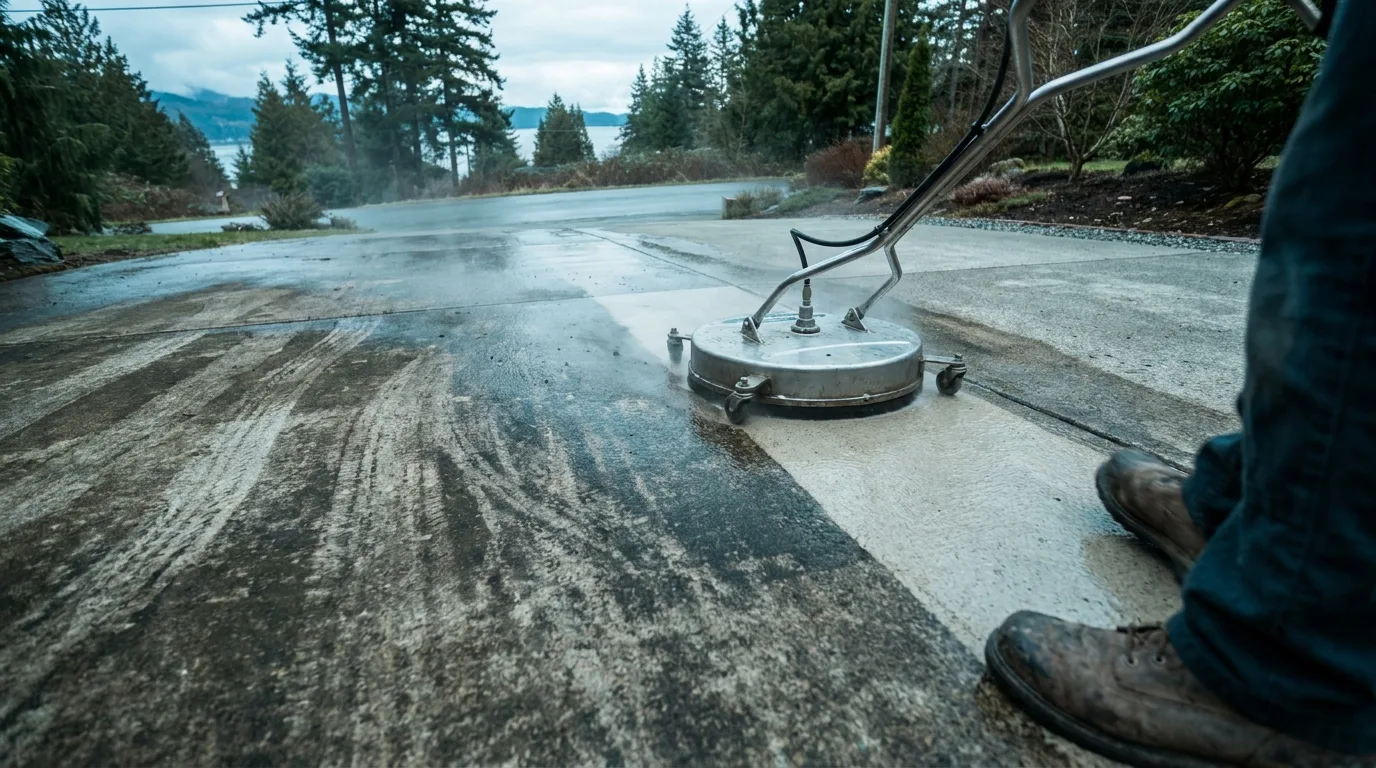
Deep cleaning of driveways and parking aprons, targeting vehicle staining — oil and fluid drips, tire scuffs, rust marks and the algae strip down the centre.
Learn more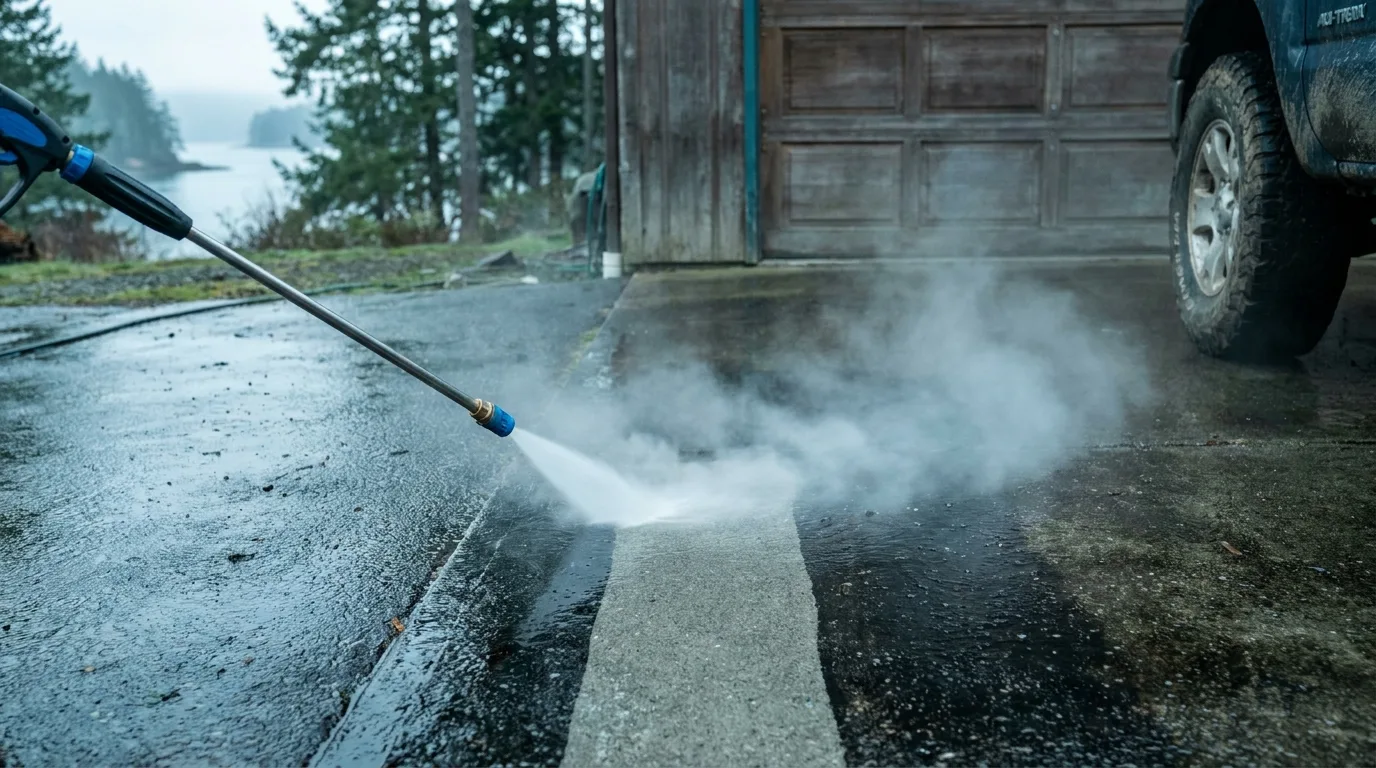
Power Washing
Hot water cleaning for the stains cold water will not lift — motor oil, grease, chewing gum, tree pitch, tar and bin-pad residue on concrete and other hard surfaces.
Learn more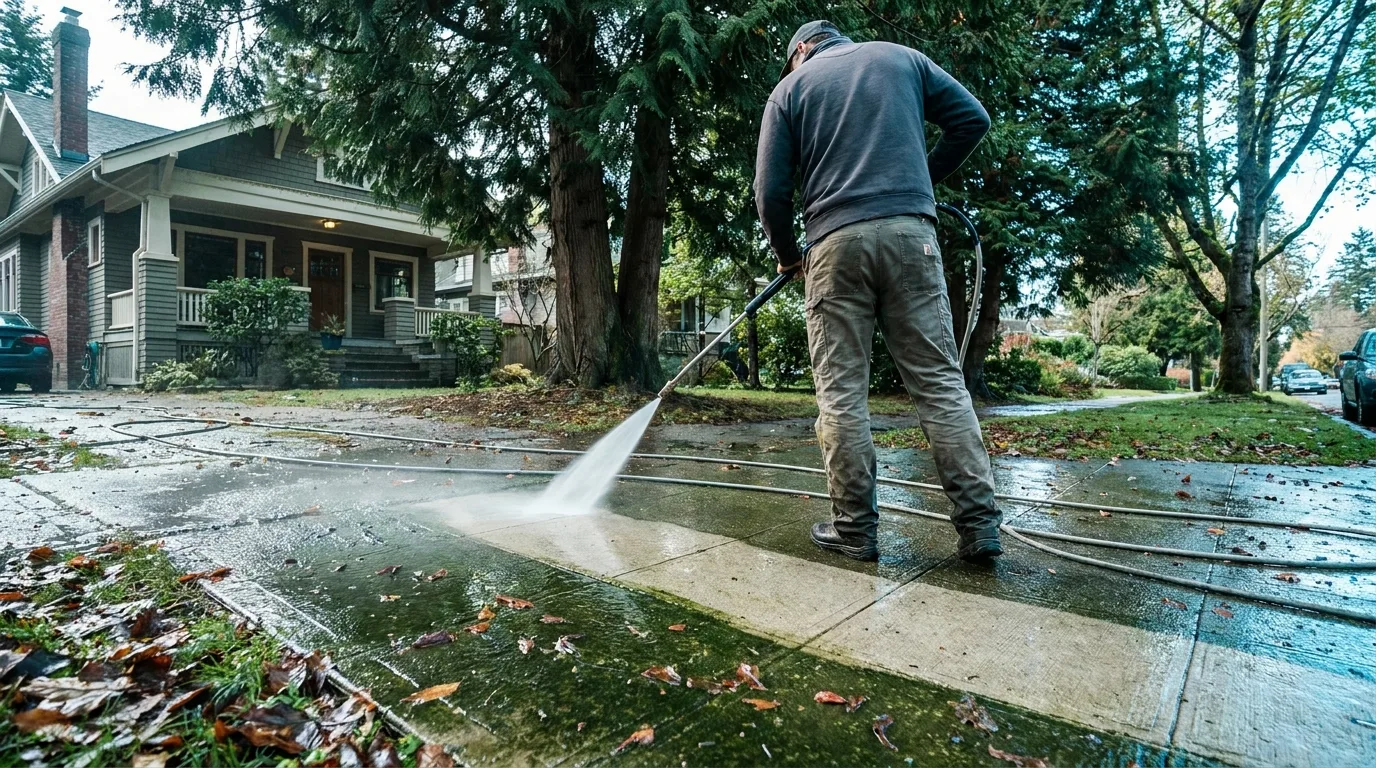
Sidewalk Cleaning
Cleaning for footpaths, walkways, entryways, strata common areas and small commercial frontages, focused on removing the slippery algae film that builds up over winter.
Learn moreOne Message and We'll Price It
The more you tell us about the concrete cleaning, the more accurate the quote.