
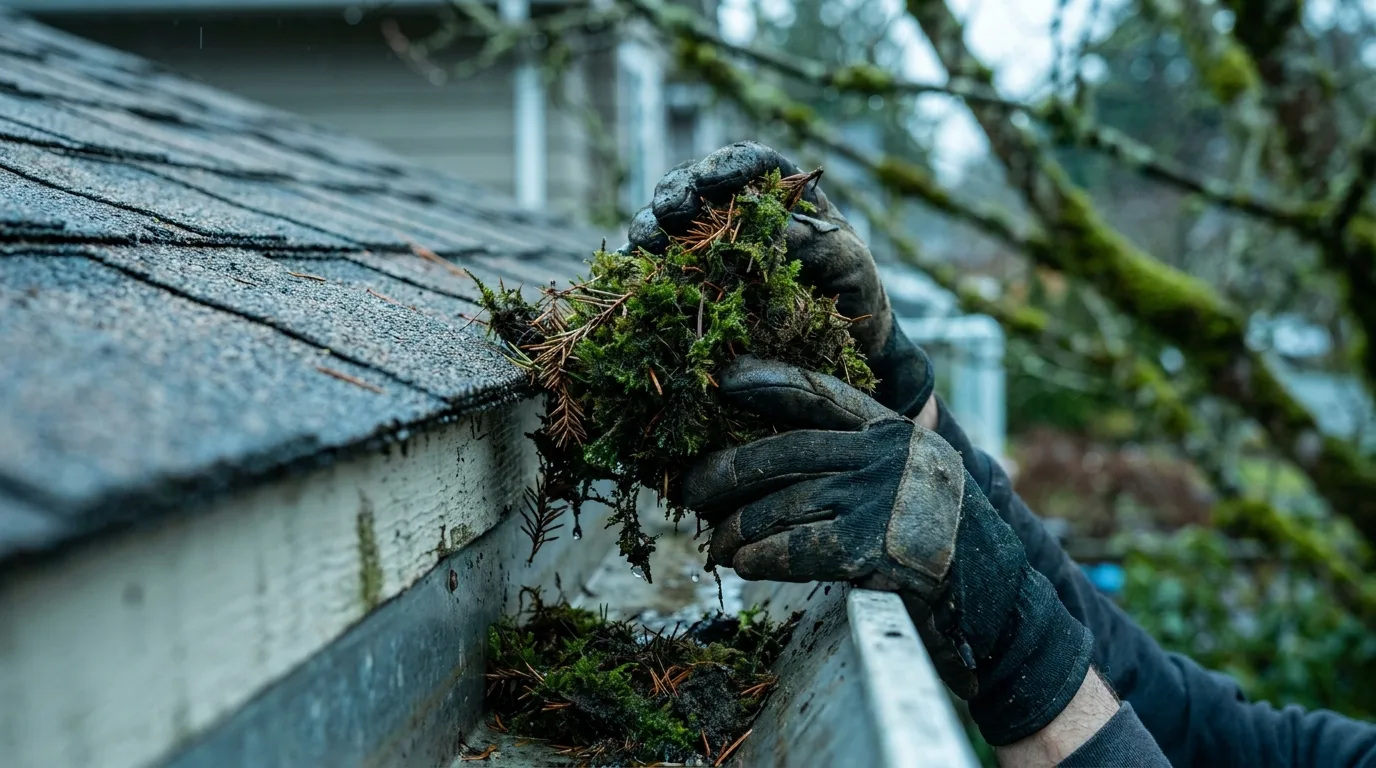
Gutter Cleaning That Checks the Downspouts
A clean trough means nothing if the downspout is still packed. We clear the whole system by hand, flush it through, and make sure water actually comes out the bottom.
Your gutters are a water-management system, not decoration. Their whole purpose is to catch what comes off a large roof and move it away from the base of the building. When they stop doing that, the water does not disappear. It goes somewhere else, and every one of those somewheres is worse.
Over the edge. A trough full of packed needles and rotted leaf mulch overflows in the first serious rain. On this coast that means a curtain of water pouring down one section of wall repeatedly all winter, soaking the siding, splashing dirt up the foundation and saturating whatever is planted below.
Behind the gutter. Debris packed against the back of the trough wicks water onto the fascia board. Fascia is timber, and timber that stays wet through a mid-Island winter rots. That rot then spreads to the gutter's fixings, which is how gutters end up sagging and pulling away from the house.
Into the ground at the foundation. Water that should have been carried out to a downspout and away instead dumps in a concentrated stream right at the base of the wall. Repeat that across a wet season and you are working on the exact spot you least want saturated.
What we actually do
Debris comes out of the trough by hand and goes into a bucket or bag, not onto your lawn, your beds or your driveway. Hand clearing matters here — blowing gutters out is fast, but it fires wet mulch across your roof, your windows and your neighbour's car, and it does nothing for the compacted sludge in the bottom of the trough.
Then the part that gets skipped. Every downspout gets flushed and checked. Outlets are where blockages actually sit: the trough drains into a small opening, and a wad of needles or a tennis ball's worth of compacted debris in that opening backs up the entire run. We flush from the top and confirm water is running out the bottom. If a downspout is packed solid, we clear it rather than noting it and moving on.
We also check the flow and fall of the run while we are up there, look for standing water sitting in a section that should drain, and note loose fixings, sagging spans, separated joints and any rot showing in the fascia behind the gutter. You get told what we found.
The mid-Island debris load
Douglas fir is the problem. Fir needles are small enough to pack tight, they shed heavily, and they do not break down quickly — they compress into a dense mat in the bottom of the trough that a leaf blower will not touch. Add big-leaf maple in the fall, cedar shed, and the shingle grit and moss fragments that wash off the roof all winter, and gutters here fill faster than most people expect.
Twice a year suits most properties with trees over them. Late spring after the maples and firs have finished dropping, and again in autumn before the winter rain sets in. Homes on open lots without overhanging trees can usually get away with once.
Gutter guards
Guards help and they are not a solution. They keep the big leaves out, which is genuinely useful, but fine fir needles either work through them or build up on top and form their own mat. The trough underneath still accumulates a fine silt. We can clean guarded gutters — it takes longer, since sections have to be lifted and refitted — and we will tell you honestly how yours are performing.
The stripes on the outside
The dark vertical streaking on the face of white gutters is a separate thing, sometimes called tiger striping. It is an oxidised film of road film and roof runoff bonded to the gutter face, and no amount of clearing the inside will touch it. It needs a dedicated cleaning solution and hand work. Ask about it when you book if the outside of your gutters bothers you — it is usually combined with a house wash, when the ladders are up anyway.
We clean gutters across Nanaimo, Lantzville, Nanoose Bay, Cedar, Parksville, Qualicum Beach, Ladysmith, Chemainus, Errington and Coombs, Monday to Friday, 9:00 AM to 5:00 PM. Quotes are free.
Plenty of gutter cleans stop at scooping out the trough — we flush every downspout and watch water come out the bottom end, because a blocked outlet is what actually causes the damage.
What You Get From Gutter Cleaning
Troughs cleared by hand and bagged, not blown across your roof and yard
Every downspout flushed and confirmed flowing before we leave
Blocked outlets cleared — the actual cause of most overflow
Compacted fir needle mulch removed, which blowing out never shifts
Loose fixings, sagging spans and separated joints reported to you
Fascia and gutter backs checked for rot and standing water
Guarded gutters handled properly, with sections lifted and refitted
Debris removed from site, leaving your beds and driveway clean
Debris removed and taken away, not flushed into the downpipe
Every downpipe tested individually rather than assumed clear
Loose hangers, sagging runs and soft fascia flagged while visible
The whole run flushed and watched to the outlet
What Gutter Cleaning Covers
A blocked gutter does not announce itself until it is already causing the damage. Water backs up over the edge, runs down the fascia, and finds its way behind the boards and into the soffit — or it overflows in one spot and saturates the ground against the foundation. On a mixed conifer and deciduous coast the debris is not seasonal in any tidy way: needles come down all year, leaves come down all at once, and a gutter cleared once a year is wrong for half of it.
How Gutter Cleaning Works
Walk the run
We check the layout, the number of downspouts, where they discharge and how much debris load the roof and surrounding trees are putting into the system.
Clear by hand
Trough debris comes out into buckets or bags section by section, including the compacted mulch in the bottom that a blower leaves behind.
Flush the system
Every outlet and downspout is flushed from the top, and we watch for water discharging at the bottom of each one.
Check flow and condition
We look for standing water, poor fall, loose fixings, separated joints and any rot in the fascia behind the gutter, and note it all for you.
Clean up and report
Debris leaves with us, splash marks get rinsed off, and you get a plain-language rundown of anything that needs attention.
The Method, in Short
Clear the troughs by hand
Debris comes out and goes in a bucket, not onto the roof or the beds below. Scooping a gutter clean and rinsing the residue into the downpipe just relocates the blockage.
Check every downpipe individually
Each outlet is flushed and watched. A gutter can be spotless and still overflow because one downpipe is packed at the elbow, which is the most common blockage there is.
Look at the fascia and the hangers
Sagging sections, loose spikes, separated joints and soft fascia are noted while the ladder is already there. Most gutter failures are visible long before they leak.
Flush and confirm the fall
The run is flushed through and watched to confirm water actually reaches the outlet, since a gutter that has dropped in the middle holds standing water and rots from there.
What It Costs
Priced on the length of gutter, the number of storeys and how much of it a ladder can reach safely. Heavily loaded troughs take longer. Quotes are free.
Gutter Cleaning by town
Tree cover, exposure and housing age change what this job actually takes. These cover it town by town.
Book Your Gutter Cleaning
Tell us about the job and we'll send you a free, no-obligation quote for gutter cleaning.
Gutter Cleaning Questions
Twice a year for most properties with fir, cedar or maple overhead — once in late spring and once in autumn before the heavy rain. Open lots with nothing overhanging can usually manage with a single annual clean.
That is a separate job. The dark vertical streaking on the gutter face is a bonded film that needs its own cleaning solution and hand work. Most people have it done alongside a house wash, and we are happy to quote both.
Usually yes, just less often. Guards keep the large leaves out but fine fir needles get through or mat on top, and silt still settles in the trough below. We can lift and refit guard sections to clean underneath them properly.
It comes out into buckets and leaves with us. Nothing gets tipped over the edge onto your beds, dumped on the lawn or blown across the driveway, and we rinse off any splash marks before we go.
It depends on what is overhead, not on the calendar. A lot with conifers on it sheds needles year-round and heaviest in late summer, so the gutters are already loaded before any leaves fall — then the deciduous drop arrives in a burst. That combination usually wants twice a year: once after the needles, once after the leaves. A genuinely open lot with nothing overhanging it can be fine on one.
They reduce the work and they do not end it. Guards keep leaves out well and fine conifer needles out poorly, and the needles are the harder problem here — they sit on top, mat down, and let water sheet straight over the front. Guards also hide the state of the trough, so the first sign of trouble is often overflow rather than a gutter you can see is full.
Water goes somewhere other than the downpipe, and the two places it usually goes are expensive. Overflowing at the back edge rots fascia and soffit and wets the wall behind. Overflowing at the front dumps concentrated water at the foundation, which is how basements get damp and how patios and paths heave. Both are far more costly than the cleaning.
You Might Also Need
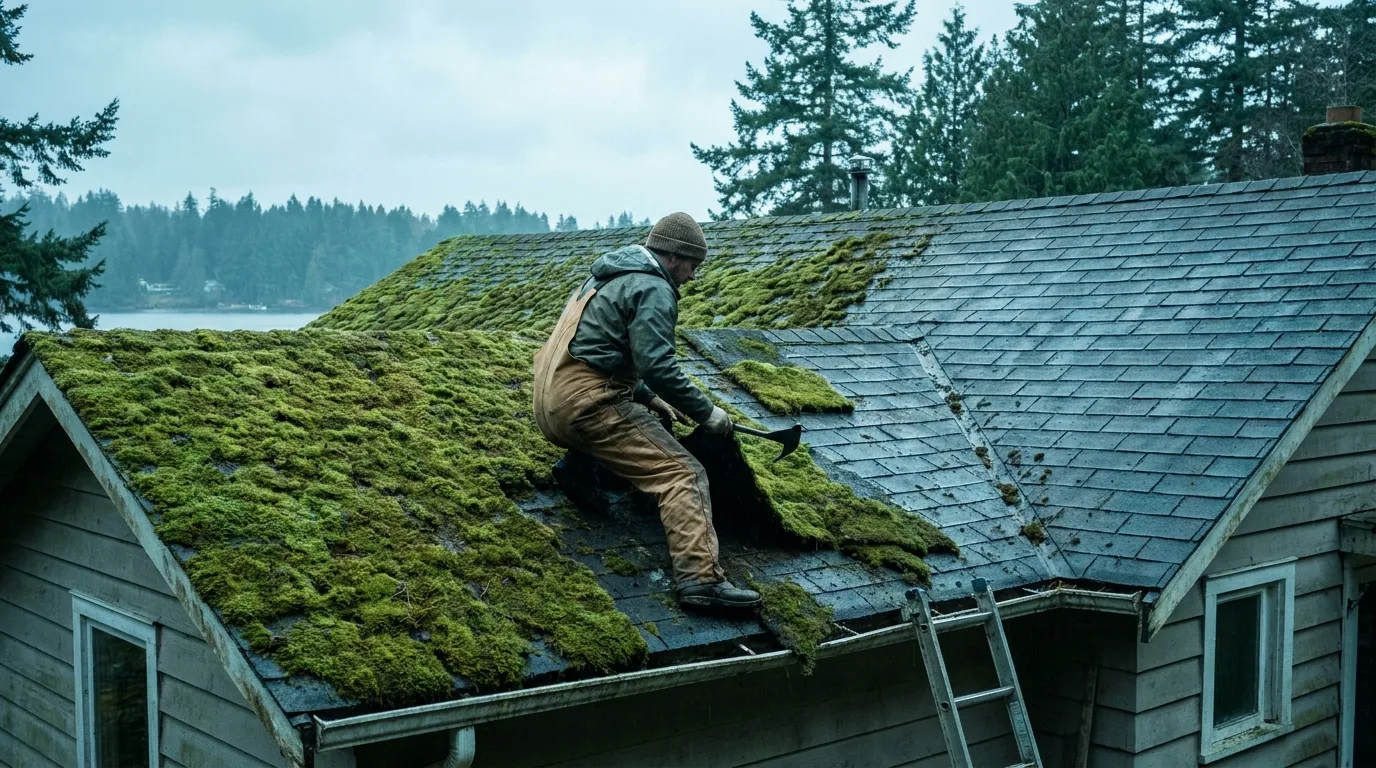
Roof Moss Removal
Careful physical removal of established moss from your roof, followed by a treatment that slows regrowth, so the moss stops working its way under your shingles.
Learn more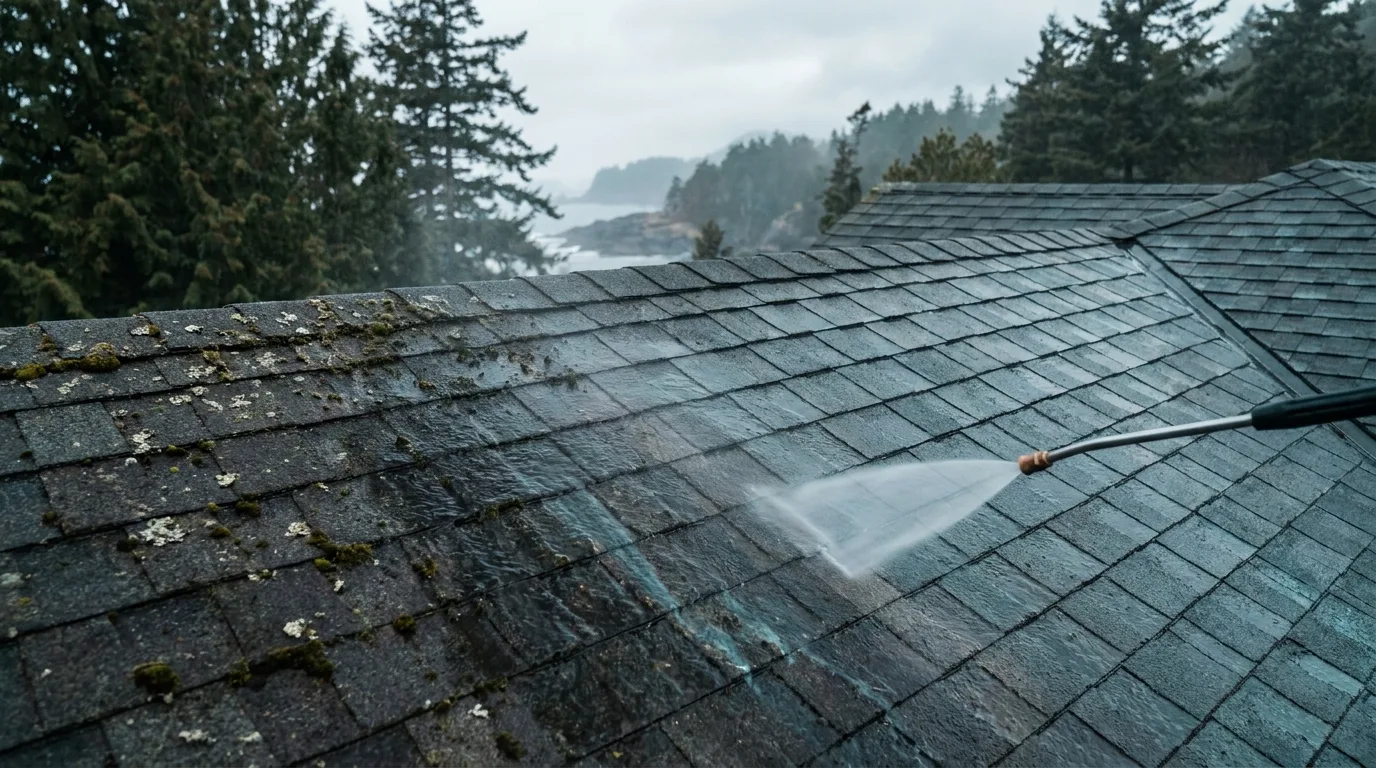
Roof Cleaning
A full low-pressure soft wash of your roof surface, clearing black algae streaking, lichen and years of general soiling without ever putting high pressure on the roofing.
Learn more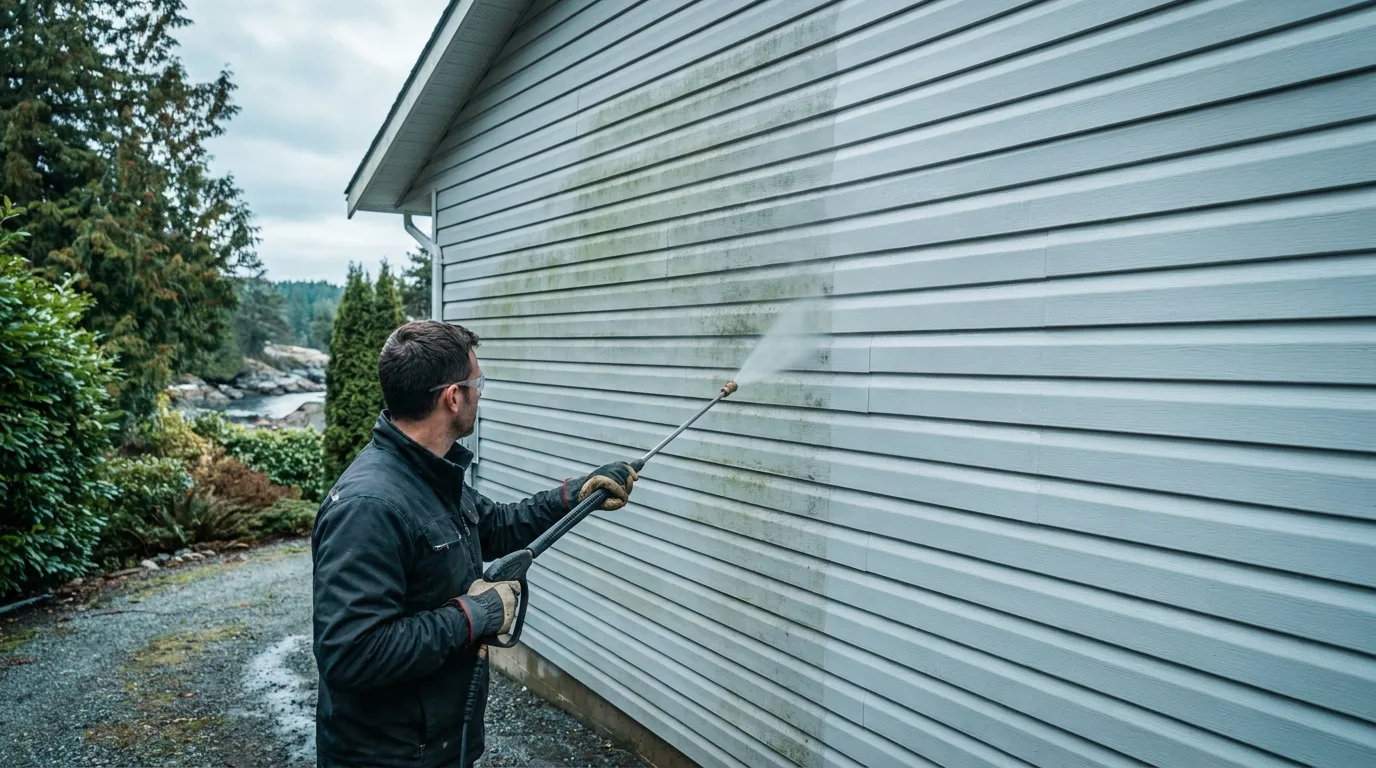
House Washing
A full soft wash of your home's exterior walls, soffits, fascia and trim, lifting algae, mildew, cobwebs and road film without forcing water behind the cladding.
Learn moreWhat Would Gutter Cleaning Cost?
Describe the surface, or send a photo of it, and we'll come back with a number.