
Driveway Cleaning in Nanaimo
Your driveway is the first thing anyone sees when they pull up, and it takes the worst of it — oil drips, tire scuffs, rust marks and a green strip growing right down the middle.
Nobody walks up to your front door without walking up your driveway first. It is the largest single surface at the front of most properties and the one that takes the hardest use, and a stained, streaked, green-edged driveway drags down a house that is otherwise well kept.
It also collects a very specific set of problems, because vehicles live on it.
The stains that come with parking a car
Oil and fluid drips. Every vehicle leaks something eventually — engine oil, transmission fluid, power steering, coolant. It pools in the same spot each time because the car parks in the same spot each time, and on a porous surface it soaks in rather than sitting on top. Water alone will not touch it. Oil staining has to be broken down chemically first, and the older and deeper the spot, the more honest we have to be about how much will come out.
Tire scuffs. The dark arcs where you turn the wheel while stationary, and the dull marks left where hot tires sit on a warm day. Hot tire pickup is a real thing — heat and plasticiser from the tire transfer into the surface, and the marks are stubborn.
Rust. Orange-brown staining from a trailer left parked all winter, a wheelbarrow, a bike rack, fertiliser tracked in from the lawn, or the steel rims of anything stored out of use. Rust is a different chemistry again and needs a rust-specific treatment; general cleaning will lighten it and not remove it.
The road-grit line at the apron. Where your driveway meets the street there is almost always a darker band of road film, brake dust, gravel wash and general highway grime. It is one of the most visible parts of the driveway and one of the least likely to get cleaned.
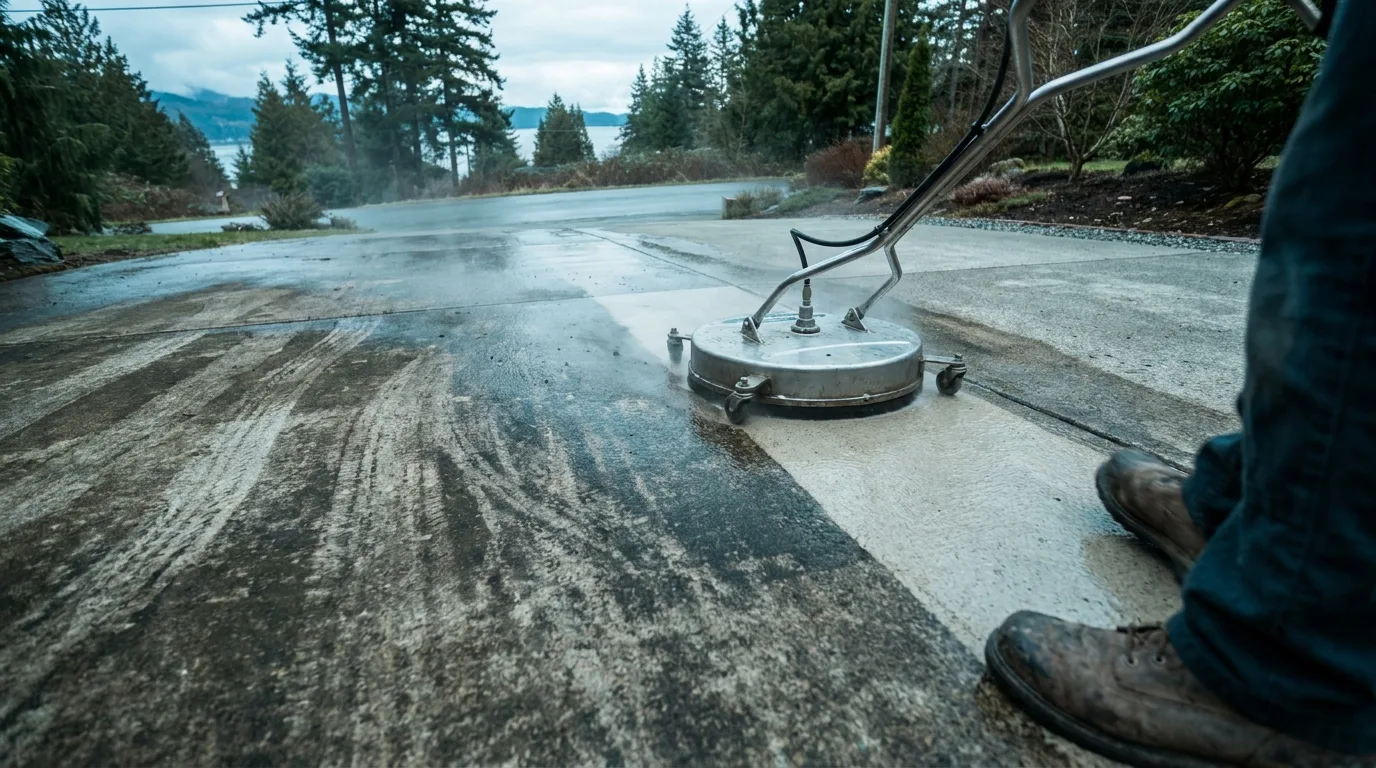
The green strip down the centre. The middle of the driveway is where tires never run, so it stays damp, and on this coast damp means algae. That strip of green running from the road to the garage is the single most recognisable "unwashed driveway" signature there is.
How we clean it
Vehicle stains get pre-treated first, spot by spot, with the right product for what they are — degreaser for petroleum, a rust-specific treatment for rust marks. That is left to work while we set up.
Then the whole surface gets cleaned with a rotary surface cleaner rather than a bare wand. This is the difference between an even result and a striped one. A surface cleaner holds a fixed distance off the ground and sweeps in overlapping passes, so the surface comes up uniformly clean. Freehand wand work leaves the arcs and zebra stripes you see on driveways done in a hurry, and those stripes are permanent until the whole thing is redone.
Edges, the apron, the garage threshold and the joins against paths and lawn get detailed by hand, because a surface cleaner cannot reach into a corner.
Asphalt is handled differently to concrete. Asphalt is a bound surface and too much pressure or too tight a stand-off will lift the aggregate and leave scars. It gets a lower-pressure approach with more reliance on cleaning solution. Interlocking pavers and stamped driveways get their own handling, and pavers usually need sand topped up in the joints afterwards.
Sealing afterwards
If your driveway is going to be sealed, immediately after a clean is the right time. Sealer applied over embedded dirt and algae seals the dirt in, and it does not bond as well. A cleaned, dried surface takes sealer properly, and a sealed driveway then resists oil soaking in, sheds water better, and stays clean noticeably longer next time.
The surface has to dry first. That is not a same-day turnaround on this coast, and it is worth waiting for a settled dry stretch rather than forcing it. Ask us about sealing when you book and we will talk through the timing.
Getting a good result
Move the vehicles out before we arrive, and give the surface a chance to dry afterwards before parking back on it. Older stains that have been sitting for years will lighten dramatically but may not vanish entirely, and we would rather tell you that up front than have you expecting a brand-new slab.
We clean driveways across Nanaimo, Lantzville, Nanoose Bay, Cedar, Parksville, Qualicum Beach, Ladysmith, Chemainus, Errington and Coombs, Monday to Friday, 9:00 AM to 5:00 PM. Quotes are free.
We treat vehicle stains as their own problem rather than hoping pressure alone lifts them, pre-treating oil, transmission fluid and rust marks before the surface clean ever starts.
What You Get From Driveway Cleaning
Oil, transmission and coolant drips pre-treated before the surface clean
Rust marks from trailers, rims and fertiliser given a rust-specific treatment
Tire scuffs and hot tire pickup targeted directly
The green algae strip down the centre cleared out completely
Rotary surface cleaner for an even finish — no wand stripes or arcs
Apron, edges, garage threshold and joins detailed by hand
Correct handling for concrete, asphalt, pavers and stamped driveways
Sealing available afterwards, when the surface will actually take it
Grip restored on a surface that gets genuinely slick in winter
Even surface-cleaner passes rather than wand striping
Moss and algae in the joints treated, not just the slab face
Runoff directed deliberately, which matters on any slope
What Driveway Cleaning Covers
A driveway is usually the largest hard surface on a property and the first thing anyone sees, but the reason to clean it is grip rather than appearance. A winter of algae film on concrete makes a surface that is genuinely slick when wet, and it is worse on a slope. Cleaning is a surface-cleaner job rather than a wand job — a spinning-bar attachment covers the area evenly instead of leaving the arcing stripes a wand always leaves behind.
How Driveway Cleaning Works
Clear and assess
Vehicles come off the driveway and we identify the surface type, the age of the staining and which marks are oil, rust or tire.
Pre-treat the stains
Degreaser goes onto the petroleum spots, rust treatment onto the rust marks, and both are left to work while we set up.
Surface clean the field
A rotary surface cleaner sweeps the main area in overlapping passes at a consistent stand-off, so the finish is uniform end to end.
Detail the edges
Apron, garage threshold, borders, expansion joints and the joins against paths and lawn get worked by hand where the machine cannot reach.
Rinse and review
The surface and surroundings get a final rinse, we walk it with you, and if you want it sealed we work out the right dry window to come back.
The Method, in Short
Read the surface and the fall
Concrete, exposed aggregate, pavers and asphalt each take different pressure, and where the water will run decides where the work starts. On a slope that matters more than anything else.
Pre-treat the growth and any staining
Algae and moss are treated before pressure is applied, and oil or rust is identified separately, because those need a different approach and will not simply rinse away.
Surface clean in even passes
A flat surface cleaner is worked in overlapping passes at consistent speed. This is what prevents the striping and zebra-patterning that a hand-held wand leaves on a large slab.
Detail the edges and manage the runoff
Edges, joints and the garage threshold are done by hand, and the runoff is directed rather than left to find its own way onto a neighbouring property or straight into a drain.
What It Costs
Priced by area, surface type and how much treatment the staining needs. Slope and where the runoff has to go can change the approach. Quotes are free.
Driveway Cleaning by town
Tree cover, exposure and housing age change what this job actually takes. These cover it town by town.
Book Your Driveway Cleaning
Tell us about the job and we'll send you a free, no-obligation quote for driveway cleaning.
Driveway Cleaning Questions
We can lighten almost all of them significantly and remove many outright, using a degreaser pre-treatment rather than pressure alone. Stains that have soaked into porous concrete over several years may leave a shadow, and we will give you a realistic expectation before we start rather than after.
Not with the right technique. Asphalt needs a lower pressure and a wider stand-off than concrete, because too much force lifts the aggregate out of the binder and leaves permanent scarring. We adjust the method to the surface, which is exactly why the results look even.
If you are going to seal, right after a clean is the time — sealer bonds properly to a clean surface instead of locking dirt underneath it. The catch is that the driveway needs a genuine dry stretch first, so we usually plan sealing as a follow-up visit.
Because tires never run there. The centre strip stays damp longer than the wheel tracks, and on the wet coast damp shaded concrete grows algae. It comes off completely with a proper surface clean, and it is usually the first thing people notice is gone.
It can if the pressure is wrong for the material. Too much on concrete lifts the cement paste and exposes more aggregate, which makes the surface rougher and the next green-up faster. On pavers, excessive pressure blasts out the joint sand and leaves the pavers loose. Asphalt is softer again. Matching the pressure and the tool to the surface is most of the skill in this particular job.
Because it was done with a hand-held wand rather than a flat surface cleaner. A wand cleans in an arc, and on a large slab the overlaps and gaps show as stripes once it dries. A surface cleaner holds the nozzles at a fixed height and spins them, so the coverage is even. Striping is a tooling problem, and it does not wash out afterwards.
Partly, and how much depends on age. Fresh oil sitting on sealed concrete comes up well. Oil that has been soaking into bare concrete for years has migrated into the pore structure, so degreasing lifts the bulk and leaves a lighter shadow behind. That ghost is the limit of cleaning rather than a job done badly — removing it entirely is resurfacing work.
You Might Also Need
Concrete Cleaning
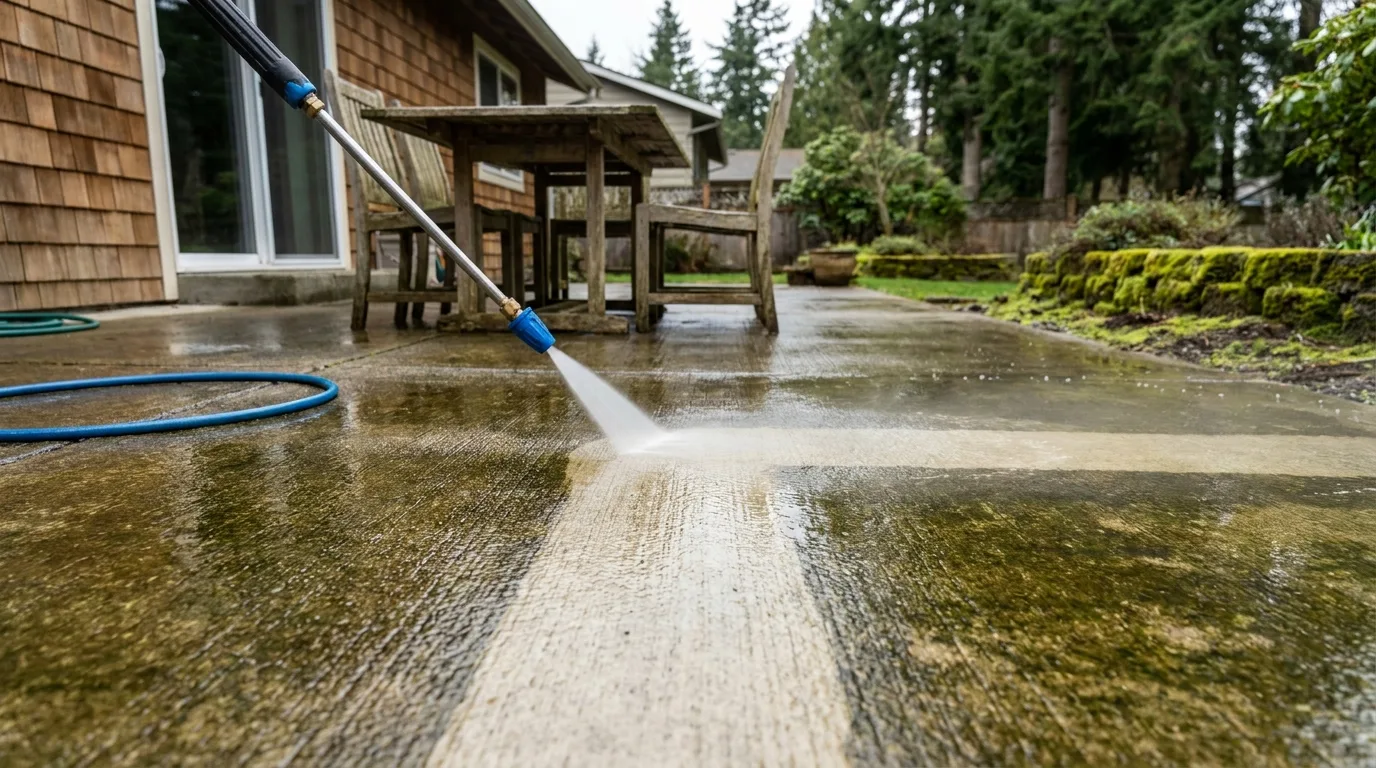
Cleaning for concrete anywhere on your property — patios, pool surrounds, garage floors, stairs, retaining walls, exposed aggregate and stamped finishes.
Learn more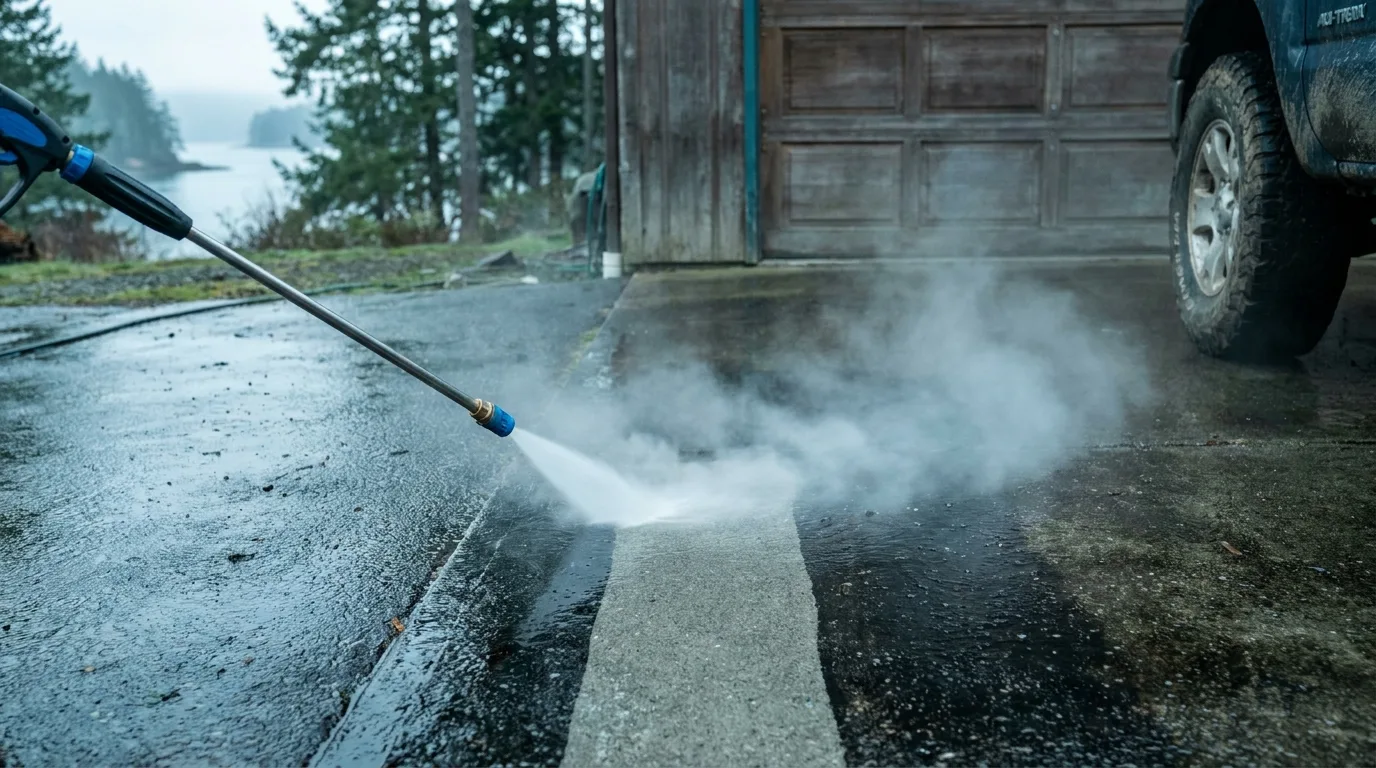
Power Washing
Hot water cleaning for the stains cold water will not lift — motor oil, grease, chewing gum, tree pitch, tar and bin-pad residue on concrete and other hard surfaces.
Learn more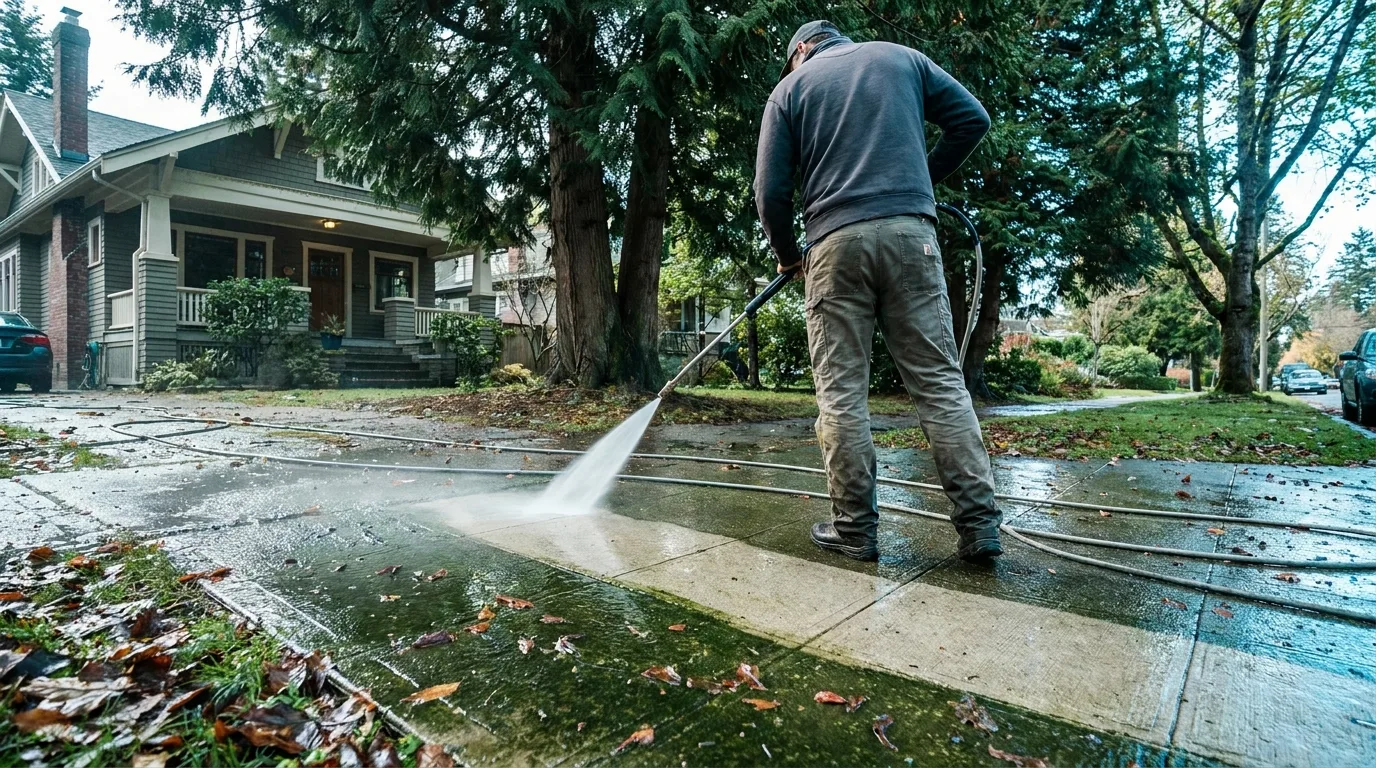
Sidewalk Cleaning
Cleaning for footpaths, walkways, entryways, strata common areas and small commercial frontages, focused on removing the slippery algae film that builds up over winter.
Learn moreLet's Get It Priced
Message us during the week and we will confirm the scope and the price before anything starts.